Showing posts with label nature. Show all posts

Thursday, July 1, 2021

Bio-agapé

How much do you enjoy creation? This is a question most people do not give much conscious thought to. Many people can tell you that they enjoy a good view, going to the beach, or some other place in nature. They may say they love being outdoors, or doing outdoor activities. But if you ask them why, you will often receive a thoughtful pause before being given some recycled shibboleth such as, "the sunshine", "fresh air" or "to get away for awhile." 

Occasionally, you will encounter an armchair philosopher who can spout paraphrases of great literary genius' such as John Muir or Henry David Thoreau. It is all too rare to converse with a person who can eloquently express the deep emotional currents stirred by encounters with the natural world. It seems modern Western society prefers to consume nature as fast-food rather than a home-cooked meal. We want it now, as much of it as we can get in as little time as possible. We care little for the nutritional value and only for the taste. 

We live indoors 90 plus percent of the time, then run to nature for a quick jaunt on the weekend. A privileged few take longer vacations in which they accrue the highlights, the best views, most iconic destinations, mostly from the comfort of a vehicle. We care for the quantity, not the quality of our nature diet. We check places off our bucket list, fill in the sticker maps on the back of our RV's. But do we take the time to get to know a place? 

Do we stop and listen to nature? Yes, we hear the sounds, but do we listen deeply, as John Muir and Henry David Thoreau listened? Their famous writings were not the result of a 30 day west coast RV tour to see all the National Parks. No. They lived in communion with nature. They consumed it as a home-cooked meal, slowly, with thoughtful appreciation to the One who prepared it. This is the recipe for developing a personal and conscious answer to the original question, how much do you enjoy creation? 

Over a life-time of nature study, biologist E. O. Wilson says he enjoys creation as much as he does being at home. He has come to believe there is an innate pull toward natural environments, especially those that resemble the African Savanah. He believes all humans share this attraction and he has termed it "biophilia" or a friendly love for nature. In other words, he believes we have a longing for creation, similar to a longing for a close friendship.1

The difficulty is that many people do not see this longing within themselves. Our reductionistic, hyperrational thinking has trained us to imagine creation as a commodity rather than a friend. We view earth in parts rather than a whole. We talk of rivers, oceans, forests, mountains as separate entities instead of portions of a totality. We often pick one as a favorite and disregard the rest. One can frequently hear questions such as, "do you prefer the mountains or the beach?" "is your favorite season summer or winter?" We can have our preferences, after all this keeps one type from being over crowded, but each one cannot exist without the other. Mountains without the ocean would be brown and barren since rain would be minimal. Summer without winter would quickly cast the global temperature balance into catastrophic chaos. The seasonal swings keep the world stable. 

We need a change in our conscious view of how we enjoy creation. Cornell Williams Brooks suggests we need more than a friendly love for nature. Biophilia may describe an innate pull in our biology. We must develop a stronger relationship if we are to maintain creation as we have been enjoying it. Brooks suggests we need a bio-agape view of creation. Only then can we truly begin to appreciate creation as God intended at the beginning. He proclaims that when we have an unconditional love for blue and green spaces, for mountains, rivers and oceans, then we will cherish the creation as a whole. We will treat it as it deserves, as a product made by the hand of the Almighty.2

Bio-agape will enable humanity to regard nature as we did before the fall, as something we know and care for intimately. It is only then that we will stop using nature in a way that benefits the few at the expense of the many. An unconditional love for the biosphere will lead us to realize that all people enjoy nature and need what it provides. Some do not have more claim to it than others. 


By David F. Garner

Sources:
1. Chris Mooney, “E.O. Wilson explains why parks and nature are really good for your brain ,”The Washington Post online, September 30, 2015, https://www.washingtonpost.com/news/energy-environment/wp/2015/09/30/e-o-wilson-explains-why-experiencing-nature-is-good-for-the-human-mind/.
2.   Cornell Williams Brooks, “The Call Of The Wild In Our Cities: Morality, Race, And The Environment,” June 21, 2021, New England Aquarium Lecture Series, 57 min 30 sec, https://thecallofthewildinourcities.splashthat.com/.

Wednesday, April 22, 2020

A Forest Hymn


THE GROVES were God's first temples. Ere man learned
To hew the shaft, and lay the architrave,
And spread the roof above them—ere he framed
The lofty vault, to gather and roll back
The sound of anthems; in the darkling wood,
Amidst the cool and silence, he knelt down,
And offered to the Mightiest solemn thanks
And supplication. For his simple heart
Might not resist the sacred influences
Which, from the stilly twilight of the place,
And from the gray old trunks that high in heaven
Mingled their mossy boughs, and from the sound
Of the invisible breath that swayed at once
All their green tops, stole over him, and bowed
His spirit with the thought of boundless power
And inaccessible majesty. Ah, why
Should we, in the world's riper years, neglect
God's ancient sanctuaries, and adore
Only among the crowd, and under roofs
That our frail hands have raised? Let me, at least,
Here, in the shadow of this aged wood,
Offer one hymn—thrice happy if it find
Acceptance in His ear.


Father, thy hand
Hath reared these venerable columns, thou
Didst weave this verdant roof. Thou didst look down
Upon the naked earth, and, forthwith, rose
All these fair ranks of trees. They, in thy sun,
Budded, and shook their green leaves in thy breeze,
And shot towards heaven. The century-living crow,
Whose birth was in their tops, grew old and died
Among their branches, till, at last, they stood,
As now they stand, massy, and tall, and dark,
Fit shrine for humble worshipper to hold
Communion with his Maker. These dim vaults,
These winding aisles, of human pomp or pride
Report not. No fantastic carvings show
The boast of our vain race to change the form
Of thy fair works. But thou art here—thou fill'st
The solitude. Thou art in the soft winds
That run along the summit of these trees
In music; thou art in the cooler breath
That from the inmost darkness of the place
Comes, scarcely felt; the barky trunks, the ground,
The fresh moist ground, are all instinct with thee. 


Here is continual worship;—Nature, here,
In the tranquillity that thou dost love,
Enjoys thy presence. Noiselessly, around,
From perch to perch, the solitary bird
Passes; and yon clear spring, that, midst its herbs,
Wells softly forth and wandering steeps the roots
Of half the mighty forest, tells no tale
Of all the good it does. Thou hast not left
Thyself without a witness, in these shades,
Of thy perfections. Grandeur, strength, and grace,
Are here to speak of thee. This mighty oak,—
By whose immovable stem I stand and seem
Almost annihilated—not a prince,
In all that proud old world beyond the deep,
E'er wore his crown as loftily as he
Wears the green coronal of leaves with which
Thy hand has graced him. Nestled at his root
Is beauty, such as blooms not in the glare
Of the broad sun. That delicate forest flower,
With scented breath and look so like a smile,
Seems, as it issues from the shapeless mould,
An emanation of the indwelling Life,
A visible token of the upholding Love,
That are the soul of this great universe.


  My heart is awed within me when I think
Of the great miracle that still goes on,
In silence, round me—the perpetual work
Of thy creation, finished, yet renewed
Forever. Written on thy works I read
The lesson of thy own eternity.
Lo! all grow old and die—but see again,
How on the faltering footsteps of decay
Youth presses,—ever-gay and beautiful youth
In all its beautiful forms. These lofty trees
Wave not less proudly that their ancestors
Moulder beneath them. O, there is not lost
One of earth's charms: upon her bosom yet,
After the flight of untold centuries,
The freshness of her far beginning lies
And yet shall lie. Life mocks the idle hate
Of his arch-enemy Death—yea, seats himself
Upon the tyrant's throne—the sepulchre,
And of the triumphs of his ghastly foe
Makes his own nourishment. For he came forth
From thine own bosom, and shall have no end.
There have been holy men who hid themselves
Deep in the woody wilderness, and gave
Their lives to thought and prayer, till they outlived
The generation born with them, nor seemed
Less aged than the hoary trees and rocks
Around them;—and there have been holy men
Who deemed it were not well to pass life thus.


But let me often to these solitudes
Retire, and in thy presence reassure
My feeble virtue. Here its enemies,
The passions, at thy plainer footsteps shrink
And tremble and are still. O God! when thou
Dost scare the world with tempests, set on fire
The heavens with falling thunderbolts, or fill,
With all the waters of the firmament,
The swift dark whirlwind that uproots the woods
And drowns the villages; when, at thy call,
Uprises the great deep and throws himself
Upon the continent, and overwhelms
Its cities—who forgets not, at the sight
Of these tremendous tokens of thy power,
His pride, and lays his strifes and follies by?
O, from these sterner aspects of thy face
Spare me and mine, nor let us need the wrath
Of the mad, unchainèd elements to teach
Who rules them. Be it ours to meditate,
In these calm shades, thy milder majesty,
And to the beautiful order of thy works
Learn to conform the order of our lives.


By William Cullen Bryant


Photo credit: Valiphotos via www.pixabay.com

Friday, July 26, 2019

Now All The Woods Are Sleeping


Now all the woods are sleeping,
And night and stillness creeping
O’er city, man, and beast;
But thou, my heart, awake thee,
To pray'r awhile betake thee,
And praise thy Maker ere thou rest.
O sun! where art thou vanished?
The night thy light hath banished--
The ancient foe, the night;
God then for now appeareth
Another Sun, and cheereth
My heart--'tis Jesus Christ, my Light!
The last faint beam is going,
The golden stars are glowing
In yonder dark-blue deep;
Such is the glory given,
When called of God to heaven,
On earth no more we pine and weep.
To rest the body hasteth,
Itself of clothes divesteth,
Type of mortality!
I'll put it off, and o'er me
Christ throw the robe of glory,
And blissful immortality!
Head, hands, and feet so tired
Are glad the day's expired,
That work comes to an end;
My heart, be filled with gladness
That God from all earth's sadness,
And from sin's toil relief will send.
Ye aching limbs! now rest you,
For toil hath sore oppressed you,
Lie down, my weary head;
A sleep shall once o'ertake you
From which earth ne'er shall wake you,
Within a cold and narrow bed.
Mine eyes scarce ope are keeping,
A moment, I'll be sleeping,
Soul, body,--fare ye well!
In grace Thy care then make them
May evil ne'er o'ertake them,
Thou Eye and Ward of Israel.
O Jesus, be my Cover!
And both Thy wings spread over
Thy child, and shield Thou me!
Though Satan would devour me,
Let angels ever o'er me
Sing, "This child shall uninjured be!"

My loved ones, rest securely,--
From every evil surely
Our God will guard your heads;
And happy slumbers send you,
And bid His hosts attend you,
And golden-armed watch o'er your beds.

By Paul Gerhardt; Translator: Catherine Winkworth

Photo credit: RitaE via www.pixabay.com 

Thursday, December 27, 2018

Christian Songs About Nature For Kids and Adults


Songs that discuss and praise God's creation are always popular. They are useful in nearly every spiritual meeting. But it can be hard to find a good one. Below I have put together a list of my favorite nature songs. I have included links to the lyrics, music (when possible), and a location where you can buy a copy of the song. I have included some especially for kids as these can be very hard to find. If you think of a song I should include please share in the comments below.

Kids Songs (birth to 12+)

Can You Be a Sunbeam?

This song is great for the little kids. It is very repetitive and includes motions to get out the wiggles. It is perfect for Sunday/Sabbath school classes, VBS, and kid specific events. But watch-out, it might get suck in your head!
Lyrics and sheet music along with music audio: Here


Down By The Creekbank

This is a classic song loved by generations of kids. It captures all the things kids love to see in nature from tadpoles to spiders. It has an easy tune that can be learned quickly. It is perfect for making up your own hand motions to represent all the animals. A wagging finger for an earthworm is always fun!
Lyrics: Here
Music audio: Here


God Made Me and All of You

This little ditty is sung to the tune of London Bridges Falling Down and should be familiar to most everyone. It is perfect for the very young kids in cradle roll because it is short. It is easy even if you are not musically inclined. 
Lyrics: Here
Music audio: Here

God Made Me

This song is also short and sweet. It is easy and perfect for the little ones and older kids too. It talks about how God made everything and ends with a thank you to God for making the animals and us. It is also easy to pick up whether you are musically inclined or not. 
Lyrics: Here
Music audio: Here

He’s Got the Whole World in His Hands

This song has a special place in my heart because I remember singing it when I was little. When I grew up I sang it when helping my mom with kids programs too. It is a bit more complex and better for kids that are in grade school. It has a fantastic message that people any age can be reminded of. Plus it has fantastic hand motions!
Lyrics and sheet music: Here
Music audio: Here
Buy song: Here

Jesus Made Me Just Like Him

This song is fun and easy. It is put to the tune of Jesus loves me. So everyone can sing along even without music. You can also simply add the first verse of this song to the song Jesus loves me along with it's many other verses. You can add motions by touching each part of the body as you sing it. Check it out.
Lyrics: Here
Music audio: Here

Seven Days of Creation Song

This is a great song for any Creation themed programs such as VBS. It progresses through creation week touching on all the things made each day. So it has several short verses. It is sung to the tune of “Are You Sleeping Brother John” which means it is an echo song. It is longer than the previous songs but is still easy to learn because it moves at a mellow pace.
Lyrics: Here
Music audio: Here

Our Wonderful World

This is a song you have likely never heard before. It was written by a friend of mine and her friend. I especially like this song because not only does it celebrate God's Creation but also encourages us to take care of that Creation. My friend is a kindergarten teacher and sings this with her class every day just before they go back inside.

                Lyrics
God made our wonderful world.
He made all the trees the grass and the flowers,
the animals, the fish, and the turtles.

We'll take care of our wonderful world.
We'll explore and discover and try to uncover
the wonderful gifts God has given.

Words By Eudora Stevens

All Ages (especially 8+)


As The Deer

This is another all-time favorite. It seems to get better with every passing year. The lyrics are basically plucked right out of a Psalm so it is timeless. It describes our longing for God as a deer thirsts for the cool mountain stream. It makes a great song at home, in church, or around the campfire.
Lyrics: Here
Sheet music: Here
Music audio: Here

God Of Wonders

This great worship song is powerful for conveying the depths of God's creation. It brings us to wonder how he made everything we can see. It is fun and upbeat and perfect for worship in church, summer camp, or anywhere.
Lyrics: Here
Music video: Here
Music chords: Here
Buy song: Here

All Things New

Another great worship song that seems timeless. It conveys a message of renewal as God makes all things new in Creation, including us. It is catchy and popular. It is a great closing song for any worship event.
Lyrics: Here
Music chords: Here
Buy: Here

All Creatures Of Our God And King

This is a great hymn found in hymnals the world over. It has been loved by generations of praising Christians. It is a resounding chorus that asks all nature to praise God along with his people. It is a moving song that speaks to the majesty of our Creator God.
Lyrics: Here
Sheet music: Here
Buy: Here

Spring Has Now Unwrapped The Flowers

Here is a little known song that nevertheless has a deep message. It describes in detail the creative power of our God. It ends with praises lifted to the maker of all we see. It is a wonderful hymn to sing in church or even home.
Lyrics and sheet music: Here
Music chords: Here
Music audio: Here

There are of course numerous other songs that could be included in this list. Both music and nature are great ways through which we can appreciate His marvelous works and praise him. Here is a list of over 100 other hymns and songs that praise God through nature: http://www.hymntime.com/tch/top/nature.htm


Written by David F. Garner

Monday, December 3, 2018

Black People And Their Fight For Equal Rights In The Outdoors

African American children with dog on the beach - Apalachicola, Florida C. 1895

In the late 19th century the back-to-nature movement began as a revolt against mass and rapid urbanization in the northern U.S. It was defined by a desire to return to the more rural countryside where fewer people lived and more open spaces existed. Cities were crowded and dirty. Many people worked in factories that were dark and noisy. Little room was left for green spaces as cities grew faster and faster with man-made structures popping up everywhere. When people no longer had easy access to open, outdoor spaces they realized how much they needed those spaces. It was a need felt by all races, religions, and socioeconomic classes.

People from every walk of life started seeking ways to leave the city if only for a few hours to reconnect with nature. This began with people riding the trolley to the end of the line or walking if they had to out of the city and into the countryside. Long walks, picnics, and eventually camping caught on as new but vital forms of recreation. People frequently picnicked in farmer’s fields, churchyards and even in cemeteries as no parks existed in most cities. This would be considered socially unacceptable today if not illegal. But at that time in history, people found natural spaces wherever they were available.

The back-to-nature movement has historically been seen as a primarily White phenomenon. But this is not the full story. Contact with nature is something everyone enjoys and is decidedly human. It is not limited to any race. Cultures throughout history have enjoyed gardens and prized natural spaces as sacred. To be human is to be a part of a larger biologically diverse community.

Black people have not historically accounted for a large percentage of outdoor recreators. But this has more to do with means and opportunity than with passion or desire. Segregated public spaces and businesses have long been a major obstacle to Black people who desired to enjoy natural areas. However, Black communities and individuals have found ways to access natural areas despite all barriers. There is no doubt they found ways to gather, recreate and relax outside even before the beginning of the back-to-nature movement.

A great example can be found in one Richard Allen. His story takes place before the back-to-nature movement. Allen was born a slave in 1760. During his childhood, he attended Methodist Society meetings and converted to the Protestant faith. As he grew older he purchased his own freedom and sought to become a preacher. At the young age of 22, he was licensed as an official Methodist preacher. At that time there was little effort to ease the plight of American slaves. Richard Allen sought to change that. Utilizing the progressive practices of the Methodist movement, Allen became a circuit preacher. He traveled by foot and horse as much as 25 miles a day around the New England States. He reported he enjoyed being outdoors despite the challenges. Wherever he went he preached his message of hope anywhere he could, often in open fields. At times barred from established churches, Allen took his message to his oppressed brethren wherever they were. He encountered much hardship and many barriers. He established the Free African Society in 1787 which provided assistance to the sick, widows, orphans, and anyone in need. His work eventually led to the creation of one of the first all-Black church in the United States —Mother Bethel African Methodist Episcopal Church. This church is still thriving today.1,2

Beginning with the freeing of all slaves after the Emancipation Proclamation and the end of the Civil War in 1865 the lot of Black people in the United States began to improve. However, things moved extremely slowly especially in the South due to discriminatory laws and attitudes. In many ways, life was as difficult and oppressive as pre-emancipation. Small freedoms became avenues through which African Americans could practice their independence. Hunting and fishing were vivid symbols of their new freedom and independence. Under the structure of slavery, White masters hunted and fished for sport. If Blacks did hunt or fish it was rarely for themselves and certainly never for recreation. With freedom came the ability to hunt and fish for themselves and their families. Still, for many, it was a requisite for survival. Poor and trapped in debt to White landlords due to unfair laws, most Blacks could not spare the resources to hunt and fish for pure pleasure until well into the 20th Century. Necessity was the prime motivation. Yet there is always a relish that accompanies these activities and although superseded by necessity, hunting and fishing provided a source of recreation. It simultaneously gave them control over their own lives and provided a means of enjoyment in the great outdoors.3

History has left us a definite record of African Americans participating in outdoor recreation on a large scale beginning in the 1890’s. Off the coast of Massachusetts in the Cape Cod islands are found beautiful beaches. Several Protestant evangelistic groups held revival meetings on the island of Martha’s Vineyard. As people attended these meetings they were impressed by the island's natural beauty. People began to frequent the island and its beaches. Black people grew especially fond of the beaches on the northeast side near Oak Bluffs because they were able to access them without the push-back of segregation. The main beach became known as Inkwell due to the predominantly Black visitors. This beach inspired the 1994 movie The Inkwell. This area became so popular around the turn of the 20th century that resort communities, many dedicated primarily to Black clientele, sprang up to accommodate the volume of visitors. This island is still a popular resort destination today.4

At the turn of the Century and into the first few decades African Americans continued to face segregation and discriminatory laws. One place provided a pleasant escape --Lincoln Hills. Lincoln Hills was a “Scenic Wonderland” in the Colorado Rocky Mountains as one advertisement put it. Beginning in 1922, Lincoln Hills slowly developed into a resort location where people, especially Blacks, could rent a cabin or a room at a lodge high in the mountains. Lots were also available for sale where one could build a private cabin adjacent to the commercial property. Lincoln Hills became a popular destination for summer vacationers in the ‘20’s and ‘30’s. It continues to be a location for outdoor relaxation and recreation today.5

Another significant event in this history was the establishment of camp Atwater in 1921 by Reverend Dr. William N. DeBerry. It was created as a summer camp especially for Black boys and girls at a time when most summer camps were segregated. It is the first known summer camp dedicated to serving Black and African American children. Camp Atwater is located in Massachusetts on the shores of Lake Lashaway. The camp is still serving kids nearly 100 years later.6

Rev. DeBerry was a visionary and anthropologist who worked hard to serve his community. He spearheaded the establishment of several church ministries dedicated to the community and especially children. These include a boy's and girl's club, women’s home, and education programs among others. He deserves to be remembered for his contributions.7

Thanks to civil rights promotion by leaders like Dr. DeBerry and to changing cultural dynamics, discussion of integration in many facets of society became ever more common. Summer camps were among those places where activists called for desegregation. In 1945 the American Camps Association became one of the first interstate camp organizations to call for inclusive summer camps. As a centralized association for summer camp leaders, it had the influence to affect change. Thanks to the ACA, camps across the United States slowly began to integrate.8

The YMCA has long provided recreational opportunities to African Americans in the United States and around the world. The first “Black YMCA” was founded in 1853 by Anthony Bowen, a former slave, only two years after the first YMCA was established in the U.S. It was located in Washington D.C.9 Others soon followed and the organization grew rapidly. The YMCA again changed recreation when they opened Camp Dudley in 1885. Because of the broad influence of the “Y”, Camp Dudley and other YMCA summer camps helped to popularize the summer camp movement across the Nation until it became a staple of American childhood. As talk of integration became common in the 1930’s and ‘40’s the YMCA leaders realized change was needed. However, at the organization level, leaders were hesitant to push camps to integrate across the country because in some regions of the country this change could have negative consequences. Instead, they left this decision up to local camp leadership. Some within the YMCA helped to improve outdoor recreation opportunities for Blacks when they began integrating camps.

First was Camp Custer, opened in 1944 in New York to serve an interracial clientele. Due to the dramatic success it achieved, in the first season, other camps in the region began integrating the following year in 1945. YMCA camps continued to integrate across the country in the following two decades with some leading the way and others only changing because of outside pressure. Summer camps run by the YMCA helped to show other camps what was possible and set a national precedent for interracial camps.10


1963 was a landmark year for the Civil Rights movement. It was the year of the March On Washington which helped to thrust the movement into the national spotlight. It was at this march that Martin Luther King Jr. gave his famous “I Have A Dream” speech. Another landmark event took place that year that helped pave the way for African Americans to access the outdoors. In the same issue of Ebony Magazine that reported the March On Washington was another report on one of the first African American mountain climbers in North America. Ebony reported that Charles Madison Crenchaw had been selected as the first Black person to attempt to climb Mt. Denali, the highest mountain in North America. The actual climb took place in 1964. Crenchaw made a successful summit and returned as a conqueror. His success became symbolic of the mountains all African Americans were seeking to conquer through the Civil Rights movement. But more than that, Crenchaw showed that mountain climbing, and the outdoors, was a place for all races. He continued climbing for multiple decades and his story still provides inspiration.
Crenchaw enjoyed climbing because it gave him a sense of “oneness with God.”11 This is a prime reason many people have enjoyed the outdoors throughout history. It is refreshing to be close to God among his Creation.

Despite all the success of the Civil Rights movement in the latter half of the 20th Century, decades of statistics have shown low participation of minorities, including Black people, in outdoor recreation and visits to national and state parks. There is a myriad of complex reasons for this including socioeconomic barriers as well as cultural barriers. Many individuals, politicians, and companies have been working to address these barriers. Some of these individuals deserve mention for the impact they have had and for carrying forward the work of earlier civil rights activists.

In 1996 two college students began a friendship that would become a nationwide movement. GirlTrek was formed in 2012 by T. Morgan Dixon and Vanessa Garrison and encourages women to use walking as a practical first step to inspire healthy living for themselves, their families and communities. Part of GirlTrek’s mission is to encourage African-American families to experience, protect and reclaim green spaces. Through walking outdoors they desire to, “Pioneer a health movement for African-American women and girls grounded in civil rights history and principles through walking campaigns, community leadership, and health advocacy.” GirlTrek has nearly 450 teams around the country and continues to grow.12

Another organization working to continue the legacy and help African Americans enjoy nature is Outdoor Afro. It is a nonprofit founded in 2009 that hosts outings, events, and workshops for many types of activities. These activities include backpacking, rock climbing, hiking, yoga, and others. Outdoor Afro serves over 30,000 people, and continues to grow. They seek to help Black people from every walk of life experience and enjoy the green spaces around them. At the same time, they work to share stories both present and past of individuals who have encountered nature in meaningful or inspiring ways. These stories help participants engage with the past and look to the future. Outdoor Afro is all about helping people have a good time and building community simultaneously.13

The history of Black people and their ability to access and enjoy natural spaces in the U.S.A. has been a story of freedom and civil rights; of hero’s, leaders and visionaries. The work is not over. Continued efforts are needed by individuals, communities, and organizations. Individuals like Dr. William N. DeBerry and organizations like Outdoor Afro and the American Camps Association. Individuals who will stand up, despite the costs and promote equality, freedom, and the ability to enjoy and preserve nature. People who will help to create a better future for the next generation. As Robert G. Stanton, first African American Director of the National Parks Service said, "if early on people develop an environmental ethic and an appreciation of their natural and cultural heritage, they will take that with them as they become a member of the Senate, become a president of a bank, or a grocer down at the corner store, or a carpenter."14

----------------

Written by David F. Garner


Sources

1. Richard Allen, The Life, Experience, and Gospel Labours of the Rt. Rev. Richard Allen (Philadelphia: Martin & Boden Printers, 1833), https://docsouth.unc.edu/neh/allen/allen.html.

2. “A Brief History of Mother Bethel African Methodist Episcopal Church,” Mother Bethel online, accessed December 1, 2018, https://www.motherbethel.org/content.php?cid=18&getmsg=yes.

3. Scott E. Giltner. Hunting and Fishing In The New South: Black Labor and White Leisure after the Civil War (Baltimore: The John Hopkins University Press, 2008).

4. Alison Rose Jefferson. “Inkwell, Matha’s Vineyard (1890s- ),” Black Past online, last modified 2017, http://www.blackpast.org/aah/inkwell-martha-s-vineyard-1890s.

5. Shereen Marisol Meraji, Laura Krantz. “During Segregation, A Mountain Oasis Gave Black Families A Summer Escape,” NPR online, last modified August 16, 2015, https://www.npr.org/sections/codeswitch/2015/08/09/427209360/during-segregation-a-mountain-oasis-gave-black-families-a-summer-escape.

6. Elwood Watson. “Camp Atwater (1921- ),” Black Past online, last modified 2017, http://www.blackpast.org/aah/camp-atwater-1921.

7. “Our History,” St. John’s Congregational Church online, accessed December 2, 2018, http://www.sjkb.org/index.php?option=com_content&view=article&id=23&Itemid=190.

8. “Establishing Racial Good Will through Camping,” Camping 17, no. 5 (May 1945): 9.

9. “History - 1800-1860s,” YMCA online, accessed December 2, 2018, http://www.ymca.net/history/1800-1860s.html.

10. Leslie Paris. Children's Nature: The Rise of the American Summer Camp. (New York: New York University Press, 2008), 261.

11. James Edward Mills. The Adventure Gap: Changing the Face of the Outdoors, (Seattle: Mountaineers Books, 2014), n.p.

12. "Our Story," Girl Trek online, accessed December 2, 2018, http://www.girltrek.org/our_story.

13. Kirsta Karlson. "Outdoor Afro Connects Participants To The Outdoors And To Black History," REI online, last modified April 10, 2018, https://www.rei.com/blog/paddle/outdoor-afro-connects-participants-to-the-outdoors-and-to-black-history.

14. Janet A. McDonnell. Oral History Interview With Robert G. Stanton, (Washington DC: National Park Service Department of the Interior, 2006): 51, https://www.nps.gov/parkhistory/online_books/director/stanton.pdf.

Photo credit: Unknown. Copyright - Public Domain

A Christmas Carol


At Bethlehem, that city blest
Did Our Lady take her rest
Mary, fair and undefiled
There conceived and bore a Child
Mater santissima
Ora pro nobis

And Saint Joseph, when he saw
Christ asleep upon the straw,
In great love he worshipped there
Mary and the Child she bore
Ave plena gratia
Ave Rosa Mundi

And the beasts that were around
Knelt upon the holy ground
And in dumb amazement they
Praised the Lord on Christmas Day
Omnia O Opera
Benedicite Dominum

But the ox that kneelèd down
Nearest to the manger-throne,
When Our Lady stroked his head,
He the Holy Credo said
“De Maria Virgine
Et est Homo factus”

And the shepherds that had heard
Of the coming of the Word
From the mouth of Gabriel
On their knees before Him fell
Sunt beati pauperi
Quorum Dei Regnum

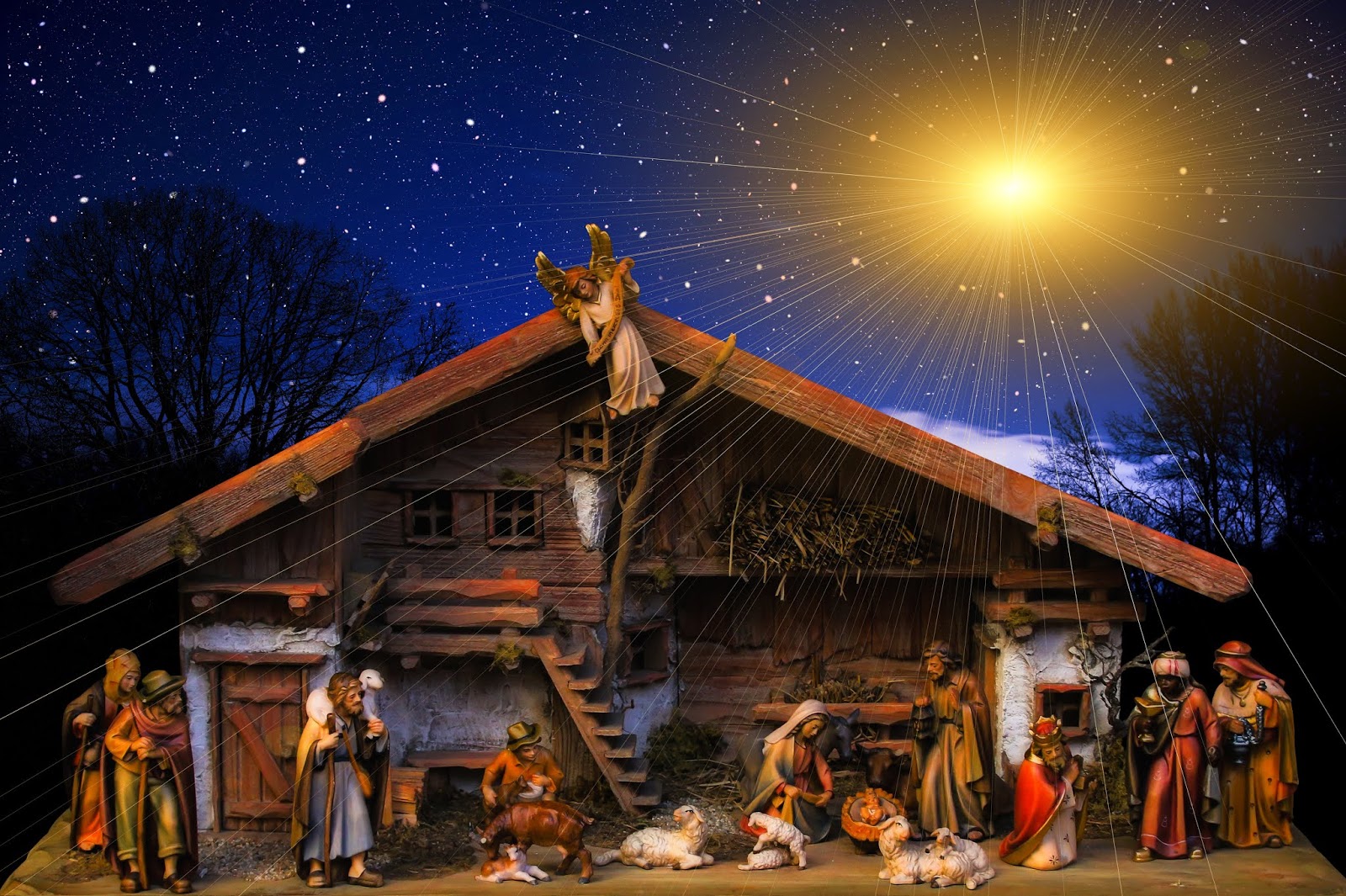
Then the kings from out of the east
Started to the Birthday feast
Came and knelt, and, as is told,

By G.K. Chesterton (unfinished poem)

Monday, November 26, 2018

The Wise Men


Step softly, under snow or rain,
To find the place where men can pray;
The way is all so very plain
That we may lose the way.

Oh, we have learnt to peer and pore
On tortured puzzles from our youth,
We know all labyrinthine lore,
We are the three wise men of yore,
And we know all things but the truth.

We have gone round and round the hill
And lost the wood among the trees,
And learnt long names for every ill,
And served the mad gods, naming still
The furies the Eumenides.

The gods of violence took the veil
Of vision and philosophy,
The Serpent that brought all men bale,
He bites his own accursed tail,
And calls himself Eternity.

Go humbly … it has hailed and snowed …
With voices low and lanterns lit;
So very simple is the road,
That we may stray from it.

The world grows terrible and white,
And blinding white the breaking day;
We walk bewildered in the light,
For something is too large for sight,
And something much too plain to say.

The Child that was ere worlds begun
(… We need but walk a little way,
We need but see a latch undone …)
The Child that played with moon and sun
Is playing with a little hay.

The house from which the heavens are fed,
The old strange house that is our own,
Where trick of words are never said,
And Mercy is as plain as bread,
And Honour is as hard as stone.

Go humbly, humble are the skies,
And low and large and fierce the Star;
So very near the Manger lies
That we may travel far.

Hark! Laughter like a lion wakes
To roar to the resounding plain.
And the whole heaven shouts and shakes,
For God Himself is born again,
And we are little children walking
Through the snow and rain.
By G. K. Chesterton
Photo credit:  27707 via www.pixabay.com

Tuesday, November 13, 2018

The Thanksgivings


We who are here present thank the Great Spirit that we are here to praise Him. 
We thank Him that He has created men and women, and ordered that these beings shall always be living to multiply the earth. 
We thank Him for making the earth and giving these beings its products to live on. 
We thank Him for the water that comes out of the earth and runs for our lands. 
We thank Him for all the animals on the earth. 
We thank Him for certain timbers that grow and have fluids coming from them for us all. 
We thank Him for the branches of the trees that grow shadows for our shelter. 
We thank Him for the beings that come from the west, the thunder and lightning that water the earth. We thank Him for the light which we call our oldest brother, the sun that works for our good. 
We thank Him for all the fruits that grow on the trees and vines. 
We thank Him for his goodness in making the forests, and thank all its trees. 
We thank Him for the darkness that gives us rest, and for the kind Being of the darkness that gives us light, the moon. 
We thank Him for the bright spots in the skies that give us signs, the stars. 
We give Him thanks for our supporters, who had charge of our harvests. 
We give thanks that the voice of the Great Spirit can still be heard through the words of Ga-ne-o-di-o. We thank the Great Spirit that we have the privilege of this pleasant occasion. 
We give thanks for the persons who can sing the Great Spirit’s music, and hope they will be privileged to continue in his faith. 
We thank the Great Spirit for all the persons who perform the ceremonies on this occasion.


Translated from a traditional Iroquois prayer

By Harriet Maxwell Converse

Friday, August 24, 2018

Near Rome


Though the hills are cold and snowy,
And the wind drives chill to-day,
My heart goes back to a spring-time,
Far, far in the past away.

And I see a quaint old city,
Weary and worn and brown,
Where the spring and the birds are so early,
And the sun in such light goes down.

I remember that old-time villa
Where our afternoons went by,
Where the suns of March flushed warmly,
And spring was in earth and sky.

Out of the mouldering city,—
Mouldering, old, and gray,—
We sped, with a lightsome heart-thrill,
For a sunny, gladsome day,—

For a revel of fresh spring verdure,
For a race mid springing flowers,
For a vision of plashing fountains,
Of birds and blossoming bowers.

There were violet banks in the shadows,
Violets white and blue;
And a world of bright anemones,
That over the terrace grew,—

Blue and orange and purple,
Rosy and yellow and white,
Rising in rainbow bubbles,
Streaking the lawns with light.

And down from the old stone-pine trees,
Those far-off islands of air,
The birds are flinging the tidings
Of a joyful revel up there.

And now for the grand old fountains,
Tossing their silvery spray;
Those fountains, so quaint and so many,
That are leaping and singing all day;

Those fountains of strange weird sculpture,
With lichens and moss o’ergrown,—
Are they marble greening in moss-wreaths,
Or moss-wreaths whitening to stone?

Down many a wild, dim pathway
We ramble from morning till noon;
We linger, unheeding the hours,
Till evening comes all too soon.

And from out the ilex alleys,
Where lengthening shadows play,
We look on the dreamy Campagna,
All glowing with setting day,—

All melting in bands of purple,
In swathings and foldings of gold,
In ribbons of azure and lilac,
Like a princely banner unrolled.

And the smoke of each distant cottage,
And the flash of each villa white,
Shines out with an opal glimmer,
Like gems in a casket of light.

And the dome of old Saint Peter’s
With a strange translucence glows,
Like a mighty bubble of amethyst
Floating in waves of rose.

In a trance of dreamy vagueness,
We, gazing and yearning, behold
That city beheld by the prophet,
Whose walls were transparent gold.

And, dropping all solemn and slowly,
To hallow the softening spell,
There falls on the dying twilight
The Ave Maria bell.

With a mournful, motherly softness,
With a weird and weary care,
That strange and ancient city
Seems calling the nations to prayer.

And the words that of old the angel
To the mother of Jesus brought
Rise like a new evangel,
To hallow the trance of our thought.

With the smoke of the evening incense
Our thoughts are ascending then
To Mary, the mother of Jesus,
To Jesus, the Master of men.

O city of prophets and martyrs!
O shrines of the sainted dead!
When, when shall the living day-spring
Once more on your towers be spread?

When He who is meek and lowly
Shall rule in those lordly halls,
And shall stand and feed as a shepherd
The flock which his mercy calls,—

O, then to those noble churches,
To picture and statue and gem,
To the pageant of solemn worship,
Shall the meaning come back again.

And this strange and ancient city,
In that reign of his truth and love,
Shall be what it seems in the twilight,
The type of that City above.


By Harriet Beecher Stowe


Photo credit: www.pixabay.com

Friday, June 22, 2018

Leadership Lesson Series: Taking A Que From Nature


"Manage an organization as nature would: A) Show neither malice nor pity. B) Abhor a vacuum, whether of power or action." - Richard S. Sloma No-Nonsense Management


Nature offers many lessons on good leadership. One of the most important is never let emotion cloud your judgement and decisions. You must show equal impartiality to all those who you lead. Once you let emotion influence your judgement, it is extremely difficult to remove it again. Not only is it hard for you to change your thinking back to that of impartiality, but your followers will expect and try to pressure you to make emotional decisions that benefit them. Emotion is a powerful human factor that leads to bad and one-sided decisions. Followers look to you to make the hard decisions that are in everyone's best interest. You can and should express empathy and understanding, you aught to be polite and respectful, but at the end of the day, an emotional decision will always come back to bite.

Another lesson is to despise a vacuum. A gap in power or action leaves a dangerous space that can quickly cause trouble. When followers sense true weakness in their leader, someone is likely to take advantage of it. True power is not control, but strength. In nature, followers always favor the strong. For leaders, a power gap often comes when they are indecisive or neglect to enforce the rules. Nature is ALWAYS decisive and NEVER neglects the rules. Of course human rules can become outdated unlike the rules of nature. So a good leader knows when to break or ignore a rule, but this is rare, not the norm. And the decision to do so must be made emphatically and never based purely on emotion. A decision to break or ignore a rule should be fair and practical.

Inaction, or a gap in action, is likewise a bane to good leadership. Inaction by a leader is often a sign of weak leadership and leaves a power gap just waiting to be filled. Inaction on the part of followers should not be tolerated, especially when in regard to their duties. Nature shows little mercy to the lazy. When you sense inaction, intervene personally. This demonstrates power which motivates action. Create a reasonable timetable for the desired action to provide accountability. A general time of inaction with noting to do is also a concern. Boredom and inactivity are a recipe for trouble. This is especially true when working with youth and young people who typically do not have fully developed reasoning skills. Always be prepared with some easy ways to fill a void of inactive time.

A third lesson that nature teaches well is that change is inevitable. Change is often a good thing, although often uncomfortable. Nature holds the key to appropriate change. Most of the time it should be slow and incremental. Too slow and people will become complacent. Too fast and some may be left behind. Yet, sometimes rapid and drastic change is beneficial. Change should be expected by both leaders and followers. This is called flexibility. The more flexible you are to change the better leader you will be.

Lastly, promote growth. Nearly everything in nature promotes growth, even death. A good leader promotes the growth of their organization or group and also those they lead along with themselves. When followers understand that you desire their personal growth as well as that of your own or your organization's, they will willingly follow. You have given them a vested interest. At times a good leader no longer seeks their own growth but only that of others. In fact, this is the ultimate goal of leadership-- think wholly of the good and growth of those you lead. When focused on the growth of others you will inextricably be promoting your own growth and the growth of your organization or group.


Written by David F. Garner

Friday, June 1, 2018

O God, This Precious Earth Thou Gave


O God, This Precious Earth Thou Gave 


O God, this precious Earth Thou gave 
To us to hold for Thee; 
Thou gave to us dominion over 
Land and over sea; 
Thou gave us mighty power over 
Creatures great and small; 
The Earth: we are responsible 
For caring for it all. 

But when we look around we find 
Our damage everywhere; 
The robins and the sparrows must 
Fly through polluted air; 
The rolling rivers have become 
Awash with our debris; 
The oceans slowly fill with trash 
Far as the eye can see.

The creatures once so plentiful 
Can scarcely now be seen; 
The forests are depleted now 
That once were strong and green; 
Where fish by hundreds once did swim 
In rivers pure and clear, 
The rivers now are toxic gray, 
And fish do not appear. 

Forgive us, God, for what we did 
 In carelessness and haste; 
We never did intend to cause 
Such damage and such waste; 
So as in sorrow we repent, 
We ask on bended knee 
To give us, God, the strength now to 
Restore the Earth for Thee. 

Amen.

by William E. McGinnis


Photo Credit: aamiraimer via www.pixabay.com

Friday, May 18, 2018

This Is My Father's World


This Is My Father's World


This is my Father's world, 
And to my list'ning ears, 
All nature sings, 
And round me rings 
The music of the spheres. 

This is my Father's world, 
I rest me in the thought 
Of rocks and trees, 
Of skies and seas 
His hand the wonders wrought. 

This is my Father's world, 
The birds their carols raise, 
The morning light, 
The lily white, 
Declare their Maker's praise. 

This is my Father's world, 
He shines in all that's fair; 
In the rustling grass 
I hear Him pass, 
He speaks to me ev'rywhere. 

This is my Father's world, 
O let me ne'er forget 
That though the wrong 
Seems oft so strong, 
God is the ruler yet. 

This my Father's world, 
Why should my heart be sad? 
The Lord is King
Let the heavens ring: 
God reigns: let the earth be glad.

by Maltbie D. Babcock

Photo Credit: 12019 via www.pixabay.com

Friday, April 20, 2018

IS NOT THIS THE LAND OF BEAULAH?


IS NOT THIS THE LAND OF BEAULAH? 


Is Not This The Land of Beulah? 
I am dwelling on the mountain, 
Where the golden sunlight gleams, 
O'er a land of wondrous beauty, 
Far exceeds my fondest dreams; 
Where the air is pure, ethereal, 
Laden with the the breath of flowers, 
They are blooming by the fountain, 
'Neath the amaranthine bowers. 
I can see far down the mountain, 
Where I wandered weary years, 
Often hindered in my journey 
By the ghosts of doubts and fears, 
Broken vows and disappointments 
Thickly sprinkled all the way; 
But the Spirit led unerring 
To the land I hold today. 
I am drinking at the fountain, 
Where I ever would abide, 
For I've tasted life's pure river, 
And my soul is satisfied; 
There's no thirsting for life's pleasures, 
Nor adorning rich and gay, 
For I've found a richer treasure, 
One that fadeth not away. 
Tell me not of heavy crosses, 
Nor of burdens hard to bear, 
For I've found this great salvation, 
Makes each burden light appear; 
And I love to follow Jesus, 
Gladly counting all but dross, 
Worldly honors all forsaking 
For the glory of the cross. 
Oh, the cross has wondrous glory! 
Oft I've proved this to be true, 
When I'm in the way so narrow, 
I can see a pathway through; 
And how sweetly Jesus whispers, 
"Take the cross, thou need'st not fear, 
For I've trod the way before thee, 
And the glory lingers near." 
Is not this the Land of Beaulah, 
Blessed, blessed land of light, 
Where the flowers bloom forever, 
And the sun is always bright?

By Anonymous  

Photo Credit: 12019 via www.pixabay.com

Friday, February 23, 2018

Nature's Temple


Nature's Temple


I love to ramble
Through bush and bramble
To the heart of God's creation
In secluded hills
Where the world is still
Beyond modern civilization
I feast my eyes
So mesmerized
By this unhindered beauty
Midst bird and tree
Where heart is free
Beyond the call of duty

The hand of God
Has brushed the sod
With emerald, bronze and amber
Since nature's birth
This niche on earth
Remains an untouched chamber
In reverence now
I humbly bow
Within this sanctuary
These wooded halls
Unbarred by walls
Beckon me to tarry

I love to ramble
Through nature's temple
For as I roam its girth
In this solitude
My heart is renewed
In the God of Heaven and earth
With sapphire and jade
It's heaven-made
Unmarred by our progression
I give to Him
My heart of sin
And He makes intercession
 
 
Source: 
https://www.christart.com/poetry/poem4857.htm 
Photo Credit: kareni via www.pixabay.com

Friday, January 6, 2017

Christian Outdoor Activity Lesson: Design In Nature


Key Text

“The works of the Lord are great, sought out of all them that have pleasure therein.” Psalm 111:2 (KJV)

Lesson

Note: This activity comes from the book A Family Guide to Sabbath Nature Activities by Eileen E. Lantry which is highly recommended.


Activity Type:
Experiential


Time:
Duration of your hike or walk.


Goal:
To discover how God used shapes and symmetry in nature to achieve beauty. Teach participants to be observant and admiring of nature. Keep participants engaged during hikes.


Material:
A notebook or scrapbook for each Pencil and colored pencils for sketching. A box or bag for nature items collected. A camera (optional).


Instructions:
This activity can become a staple of your outings. As the author notes, “There is no limit to the possibilities you may achieve… as you awaken an interest in God's magnificent artistry in designs in nature by creative thought, thrilling observation, exciting collecting.”1 This activity is also great for introducing inner city participants to the beauty of nature.

“Set aside at least three pages each in your notebook or scrapbook for the three kinds of lines: 1. Straight lines. 2. Curved lines. 3. The S-curve.”1 As you walk look for examples of these three types of lines in nature. Stop to examine what you see. Focus only on God’s created things. Write down your discoveries, draw them, or photograph them. If possible, collect or preserve specimens (make sure this is permissible in your area, some locations prohibit picking flowers).

Straight Line Examples: 1. Bills of many other birds: hummingbird, kingfisher, 2. Last joint on the legs of most insects, called tarsus. 3. Segments on the long, slender abdomens of dragonflies 4. Center vertical trunk of trees. Curved Line Examples: 1. Blades of grass. 2. Stems of plants. 3. Tails of most animals. The S-Curve: Examples: 1. Necks of herons, swans, and many ducks. 2. A snake in motion. 3. A crawling worm.

This activity can be done with many other shapes as well such as circles, triangles, squares, spheres, crosses, bilateral symmetry, etc. The book contains spiritual applications for these and more! 

Possible Lesson

Spiritual application as stated by the author: “Lines are infinite, endless, stretching on and on. The harmony of the beauty of nature, like the music of a mighty orchestra, stretches on and on like an endless line, giving joy and pleasure. It can illustrate the worldwide progress of the everlasting gospel of Jesus with its limitless outreach. Like a straight line there is no end. Then in another sense straight lines often determine limits or boundaries. God commands nature as well as men, ' 'Thus far; no farther." To stay within the limits or boundaries of God's will for us brings only joy, peace, and happiness. Going beyond the LINE or limit of God's will places us on Satan's ground, which ultimately brings trouble, disaster, and unhappiness.”1

“Curved lines are more graceful and more numerous in nature than straight lines. The soft, curved lines are not only more beautiful to the eye but more relaxing. In this exciting, stressful world, God placed the restful curved line everywhere as a reminder to 'come apart" and enjoy the quiet calm and peace of knowing Him. Nature's endless use of curved lines is like the words of Jesus, "Peace is my parting gift to you, my own peace, such as the world cannot give. set your troubled hearts at rest, and banish your fears." John 14:27, N.E.B. He also placed the curved line of the rainbow in the sky, a sign of His promise to all.”1


Sources

1 Eileen E. Lantry, A Family Guide to Sabbath Nature Activities, (Boise: Pacific Press Publishing Association, 1980), 25-28.

Written By David F. Garner
Photo Credit: Pixabay.com

Wednesday, March 2, 2016

Christian Outdoor Object Lesson 23: The Fingerprint of God

Photo Credit: Stefan Schweihofer (username: stux)


Key Verse

“The heavens declare the glory of God. The expanse shows his handiwork.” Psalms 19:1 (WEB)

Lesson

What evidence is there that God really created the universe, you, and me? How do we know that God deserves our praise? Sometimes it seems hard to know where everything came from. We hear all sorts of ideas about where we came from and how the world got here. Thankfully, God did not leave us to guess about these questions. Have you ever noticed all the beauty in nature? Why is there beauty? Science exists to tell us how things work. But religion helps us find out why. The Bible tells us that God made everything to show us his glory, or his wonder and majesty. It also tells us that he created this earth for our pleasure and to show us he loves and cares for us. That is why beauty exists. That is why everything exists.

Have you ever looked at something in nature and thought, “that could not have happened by accident? It must have been made and designed.” We know when we find a plastic bottle on the ground that it was made by humans. We also know someone threw it there instead of in a trashcan. We understand that it did not grow there naturally.

In nature we see evidence of a designer. Once such evidence is the Golden Ratio (a.k.a. the Fibonacci Sequence). In math this is a series of numbers where the next number is the sum of the two proceeding numbers. (Example: 1,2,3,5,8,13, etc.) It can get very complex. But the Golden Ratio translates into a spiral pattern we see often. It appears all around us in nature from the smallest to the biggest things. It is seen on the pinecone bottom, snail shells, the shape of ocean waves, even the spiral of galaxies. It can be seen in the center of flowers in the composite family such as the sunflower. The Golden Ratio has been called the fingerprint of God because it appears from the smallest atom to the biggest galaxy. It is like God’s signature in creation. And best of all, it adds beauty.


Psalms 19:1 says that the heavens declare God’s glory and show how powerful he is. He is the God of creation; the One who made everything else that exists. No one is greater. That is why he deserve our praise. Romans 1:20 tells us that nature points to the all powerful God. It shows he is there and that he cares for us. So we have no excuse to think he is not there or that he does not take care of us. God loves each of us. And he made everything good you can see just to prove it.

Questions

How do you see design displayed in nature?

How do you think God feels when we destroy his creation?

What do you think God thinks about all the ways his creation has been messed up since Adam and Eve sinned?

In what ways can we show God our thanks and praise for what he made?