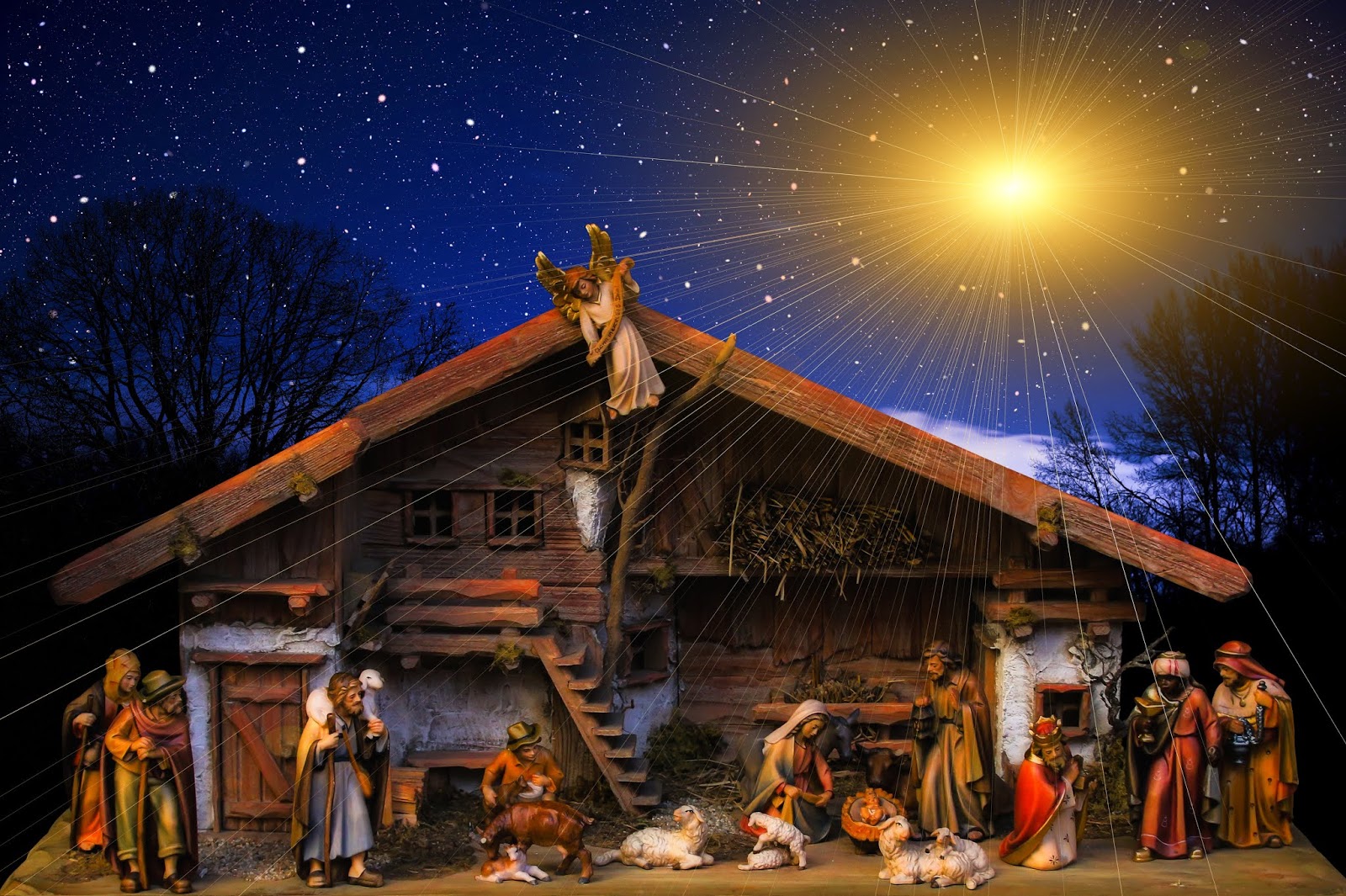
Showing posts with label christmas. Show all posts

Friday, December 25, 2020

Outdoor Object Lesson 112: The Savior's Wreath


Key Text

"They braided a crown of thorns and put it on his head, and a reed in his right hand; and they kneeled down before him and mocked him, saying, “Hail, King of the Jews!”" Matthew 27:29 (WEB)


Lesson


A Christmas wreath is one of the most recognizable decorations, second only to the Christmas tree. Wreaths have been used continually since ancient Greece. The Greeks used them as a symbol of honor and victory. When an Olympian won a race he was presented with a wreath of greenery to wear on his head. Greek kings work a golden and jeweled wreath, called a crown, as a symbol of their position. This became a common symbol used by monarchs for thousands of years. The Greeks also hung wreaths over their doorway after the harvest as a symbol of prosperity and blessing that would see them through to the next spring. The wreath was later used by the Romans and then Medieval Europeans for similar purposes. 

The Romans valued heroes above all else. The highest honor they could bestow was a wreath woven of grasses and flowers. These were reserved for military generals and commanders who heroically rescued an army threatened with defeat. The rescued soldiers would fashion the wreath out of grasses growing right on the battlefield and present it to the General as a sign of gratitude for saving them. The General then wore this on his triumphal procession.1 

When Jesus was being led to the cross, the Roman soldiers put a staff in his hand and fashioned a wreath of thorns which they put on his head. They then mocked him because he claimed to be a king. The wreath of thorns was meant to mock the wreath given to heroic generals. What they didn’t realize is that he was about to die in order to save them and the rest of the world. Jesus was the ultimate Savior. The soldiers fashioned a wreath out of thorns from the battlefield--earth. The thorny crown they placed on his head was the very curse of sin God pronounced on the world after Adam and Eve's fall in Genesis 3:18. Jesus wore the wreath as he died thus claiming victory over sin and Satan. 

At Christmas time we place beautiful green wreaths outside our homes. They celebrate the prosperity and blessings God has given us that will sustain us into the new year. When you look at a Christmas wreath this season, remember that Christmas is about the birth of the Savior who came to rescue us. When Jesus returns the next time, he will no longer be wearing a wreath of thorns, he will be wearing many crowns (Revelation 19:2)! He will be wearing golden and jeweled crowns of all the nations because he is the mighty King who saved them all from defeat!


By David F. Garner

Photo credit: JillWellington via www.pixabay.com

Sources: 
1. CAleb D Parker, "The Many Coronas of Ancient Roman Society," Medium.com, June 28, 2020, https://medium.com/@CalebDParker3/the-many-coronas-of-ancient-roman-society-55eb0974cddc

Monday, December 17, 2018

Outdoor Object Lesson 87: Reindeer Gospel


Key Text

"For so has the Lord commanded us, saying, ‘I have set you as a light for the Gentiles, that you should bring salvation to the uttermost parts of the earth.’” Acts 13:47 (WEB)

Lesson

Rudolf the red-nosed reindeer. We all know the story. A young reindeer who is shunned and teased because he looks different with his bright red nose. But his seeming handicap turns out to be just what Santa needs and so Rudolf finds his purpose in the world. Reindeer are unique and almost magical creatures to most of the world because of Christmas myths and where they live. Reindeer make their home so far north few people will ever see them more than once or perhaps not at all.

Reindeer are also called caribou in North America and are rather interesting creatures. Both male and female grow impressive antlers. They are able to survive in subzero temperatures and blinding blizzard weather. Some species have knees that make a clicking noise that helps the herds stay together when it’s hard to see. They also have hooves that expand in the summertime when the ground is soft and shrink in winter when it’s hard. Reindeer are known to migrate as much as 3000 miles (4800 km) per year in search of food which is a record among land animals. Reindeer have specially designed noses that warm the frigid air before it enters their lungs.1

Their nose is able to do this thanks to an enormous blood supply that circulated through their nose. This blood flow actually turns the tip of their nose red at times. Robert May, the creator of the Rudolf story, might have been inspired after seeing a reindeer with a red nose in real life. The distinctive red hue is not bright enough to guide a sleigh, but it is a marvelous tool for regulating body temperature. Scientists have discovered that in addition to warming air, a reindeer's nose acts to release body heat in their head. This helps to keep their brain at a proper temperature. Reindeer are truly amazing creatures.


We like Rudolf all have a blemish. There is definitely something wrong about us. We have all felt the sting of other people making fun of us and this can bring our faults to the surface. I am not talking about external blemishes or even problems inside the body, I am talking about defects in our hearts and our personalities. We have a selfishness problem. While it is no fun to be made fun of or shunned like Rudolf, we have also acted like the other reindeer at times and made fun of or shunned others. There is good news. When we give ourselves to Jesus, he will show us how to live for others. The gospel of Rudolf's story is that there is one Person who can take our defects and make them into something that gives light to the world.

Questions

How do you feel when others make fun of you?
Do you think Santa let the other reindeer make fun of Rudolf?
What does the Bible teach about having the qualifications to be used by God?
What is one way to can use your defects to spread the Gospel of Jesus?

Sources

1. Joseph Stromberg, "The Scientific Reason Why Reindeer Have Red Noses," Smithsonian online, last modified December 18, 2012, https://www.smithsonianmag.com/science-nature/the-scientific-reason-why-reindeer-have-red-noses-166263479/.


Written by David F. Garner
Photo credit: Natalia_Kollegova via www.pixabay.com

Monday, December 10, 2018

Outdoor Object Lesson 86: Red and Green


Key Text

"If I go and prepare a place for you, I will come again, and will receive you to myself; that where I am, you may be there also." John 14:3 (WEB)

Lesson

What is red and green all over? It probably did not take you long to guess Christmas. These two colors are often considered the official colors of the holiday. But other colors are popular too. Blue, gold, silver, and white can be seen adorning nearly every home and shop at Christmas. Red and green still seem to dominate all others. It hasn’t always been that way. Until the early 20th century many colors were used in decorations as much as any other. But red and green slowly came to prominence with time.

In colder climates in Europe and North America, the dark green holly plant with its bright red berries are a familiar and welcome sight. They are one of few plants that grow in the cold months and stick out against the snow. Holly is able to grow even in winter because it is an evergreen. It can tolerate temperatures as low as 20 degrees F (-6 degrees C).1 Holly has long been a symbol of hope of coming spring. So the holly branch has been associated with the Christmas season for centuries. The holly branch helped to make red and green the most popular Christmas colors.

This hope is mirrored in the hope of the Christmas story in which the birth of Jesus symbolized the coming hope of his mission. The birth of Jesus did not in itself bring salvation. Jesus still had to grow up. He had to complete his ministry and train disciples to carry his message to the world. Then he had to choose to go to the cross and die for our sins. But the birth of the Messiah brought hope. It was a sign that God was in the process of carrying out his promise. It was a symbol of hope.

God is now in the process of carrying out another promise. He is working to prepare a place for you and me so that he can come again and take us to live with him for eternity. As Jesus promised in the key text, he will come again and take us back to heaven with him. Christmas is the celebration of the first advent of Jesus and a reminder that Jesus fulfilled God's promise of a redeemer to save the world. When you look at the red and green decorations this Christmas season, let them remind you that like the holly is a promise of the coming spring, so Christmas is a promise of a savior that is coming a second time.

Questions

What is your favorite Christmas color?
What else does Christmas give us hope for?
Why has Jesus not returned yet?
How long will it be to Jesus comes back?

Sources
1. "AMERICAN HOLLY," University of Kentucky, Department of Horticulture online, last updated December 7, 2018, from http://www.uky.edu/hort/American-Holly.


Written by David F. Garner

Monday, December 3, 2018

A Christmas Carol


At Bethlehem, that city blest
Did Our Lady take her rest
Mary, fair and undefiled
There conceived and bore a Child
Mater santissima
Ora pro nobis

And Saint Joseph, when he saw
Christ asleep upon the straw,
In great love he worshipped there
Mary and the Child she bore
Ave plena gratia
Ave Rosa Mundi

And the beasts that were around
Knelt upon the holy ground
And in dumb amazement they
Praised the Lord on Christmas Day
Omnia O Opera
Benedicite Dominum

But the ox that kneelèd down
Nearest to the manger-throne,
When Our Lady stroked his head,
He the Holy Credo said
“De Maria Virgine
Et est Homo factus”

And the shepherds that had heard
Of the coming of the Word
From the mouth of Gabriel
On their knees before Him fell
Sunt beati pauperi
Quorum Dei Regnum

Then the kings from out of the east
Started to the Birthday feast
Came and knelt, and, as is told,

By G.K. Chesterton (unfinished poem)

Outdoor Object Lesson 83: Poinsettia’s Point


Key Text

“how much more will the blood of Christ, who through the eternal Spirit offered himself without defect to God, cleanse your conscience from dead works to serve the living God?” Hebrews 9:14 (WEB)

Lesson

No flower embodies the Christmas season more than the poinsettia (Euphorbia pulcherrima). In fact, no other plant except the Christmas tree comes close to the same popularity this time of year. But why did this flowering plant become so popular? Afterall there are numerous red flowers in nature. Poinsettias were discovered and named by Dr. Joel Roberts Poinsett, an amateur botanist and the first United States ambassador to Mexico. He discovered this beautiful bush growing in Mexico in 1828. He was responsible for importing and popularizing the bush in the United States.

One primary reason this plant became popular at Christmas time is because December is the only time of year that poinsettias bloom. Their brilliant red leaves are the perfect color to adorn the Christmas story. Red and green have long been associated with the Christmas season although not always as dominant as today. Poinsettias have been a staple of church decorations in Mexico at Christmas time for hundreds of years. As they spread in popularity in the United States, they easily became a staple of Christmas décor because they are one of few plants that bloom in December, especially in the northern climates.

Another reason poinsettias became popular in churches at Christmas time is because to the Aztecs of Mexico the color red represented purity. As Christianity spread in Mexico the poinsettia naturally became a dominate fixture in churches at Christmas time. In the Bible the color white is most often associated with purity. White is clean, and even the slightest bit of impurity is easily seen against a white background. So, it is easy to see why it represents purity. In the Bible red can also represent purity because of the blood of sacrifices. In the key text we see the blood of Jesus’ sacrifice used to symbolically cleans and purify us from sin.

Poinsettias are an amazing plant. They can grow into small trees in their native region reaching 12 feet (3.7 m) high with leaves 8 inches (20.3 cm) wide. It is actually their leaves that turn red. Many people mistake the red leaves as flower petals. On most flowering plants the petals have the bright colors. That is not so with poinsettias. The flowers are very small, unremarkable yellow buds at the center of the brightly colored leaves. Poinsettias come in a variety of colors including white, pink, salmon, cream, yellow, and most popular, red. You may see blue or other colors, but these have been dyed. Whenever you look at a poinsettia this Christmas, whether white, red, or some shade in between, remember what Jesus has done for you. Jesus shed his blood so that we could be purified and live with him eternally. Let that be an ever-present thought in your mind when you see a poinsettia.

Questions

What is your favorite Christmas decoration?

Why do you think red and green are the most popular Christmas colors?

How does the blood of Jesus make us pure?

What are some ways you can help to keep Christ at the center of Christmas this year?

Sources

1. Dr. Leonard Perry. “Fun Facts About Poinsettias,” The Green Mountain Gardener online, (Burlington: University of Vermont Extension Department of Plant and Soil Science) accessed December 3, 2018, https://pss.uvm.edu/ppp/articles/points.htm.


Written by David F. Garner
Photo credit: sandid via www.pixabay.com

Monday, November 26, 2018

The Wise Men


Step softly, under snow or rain,
To find the place where men can pray;
The way is all so very plain
That we may lose the way.

Oh, we have learnt to peer and pore
On tortured puzzles from our youth,
We know all labyrinthine lore,
We are the three wise men of yore,
And we know all things but the truth.

We have gone round and round the hill
And lost the wood among the trees,
And learnt long names for every ill,
And served the mad gods, naming still
The furies the Eumenides.

The gods of violence took the veil
Of vision and philosophy,
The Serpent that brought all men bale,
He bites his own accursed tail,
And calls himself Eternity.

Go humbly … it has hailed and snowed …
With voices low and lanterns lit;
So very simple is the road,
That we may stray from it.

The world grows terrible and white,
And blinding white the breaking day;
We walk bewildered in the light,
For something is too large for sight,
And something much too plain to say.

The Child that was ere worlds begun
(… We need but walk a little way,
We need but see a latch undone …)
The Child that played with moon and sun
Is playing with a little hay.

The house from which the heavens are fed,
The old strange house that is our own,
Where trick of words are never said,
And Mercy is as plain as bread,
And Honour is as hard as stone.

Go humbly, humble are the skies,
And low and large and fierce the Star;
So very near the Manger lies
That we may travel far.

Hark! Laughter like a lion wakes
To roar to the resounding plain.
And the whole heaven shouts and shakes,
For God Himself is born again,
And we are little children walking
Through the snow and rain.
By G. K. Chesterton
Photo credit:  27707 via www.pixabay.com

Friday, December 22, 2017

Christian Outdoor Object Lesson 58: Oh Christmas Tree


Key Verse

Evergreens will grow in place of thorn bushes, firs will grow in place of nettles; they will be a monument to the Lord, a permanent reminder that will remain. Isaiah 55:13 (NET©)

Lesson

The Christmas Tree is perhaps the most iconic symbol of Christmas, and one of the loveliest. Why do we decorate a tree in honor of the birth of the Savior of the world? Christmas trees are typically Evergreen trees (Latin: sempervirens). Evergreens include pines, firs, cedars, and cypress. Evergreens get their name because they are always green, even through long cold winters. Evergreens have been a symbol in many cultures of the promise that winter will end and spring and sunshine will come again.

The modern Christmas tree can trace its roots to the tradition of the “paradise tree” in the Middle Ages. These trees had fruit hung in them representing the lost Garden of Eden, paradise, which Christ came to restore. Over the centuries ornaments, candy, and candles slowly replaced the hanging fruit.1,2  Christmas trees have been topped with many things throughout history. The two most common tree toppers are the star and the angle. The star represents the Star of Bethlehem that appeared as a sign of the coming Messiah and led the wise men to Jesus (Matt. 2:2). The angle represents those angles in the story of Jesus that announced his birth to the shepherds (Luke 2:8-14).

Christmas trees are often decorated with fabulous colors. These colors hold spiritual meaning: red represents the sacrifice of Jesus, green represents hope of coming spring and of Jesus’ soon return, gold symbolizes the majesty of Jesus, white represents the purity of Jesus, silver represents our redemption, blue symbolizes the royalty of Jesus as King.

At the center of Christmas decorations is the tree itself. This is the most important piece. It is the pillar that never dies; it offers hope in the deepest, darkest winter. Long before the Christmas tree, God, speaking through Isaiah, pointed to the evergreen tree as a permanent symbol of his promise, and Jesus is that promise.


Questions

What is your favorite Christmas tradition?

What other parts of Christmas represent the story of redemption?

How does gift giving symbolize Jesus?

What can we do to keep Christ in Christmas?


Sources

1 Edwin and Jennifer Woodruff Tait. “Why Do We Have Christmas Trees?” (December 11, 2008). Christianity Today. Accessed December 21, 2017 from http://www.christianitytoday.com/history/2008/december/why-do-we-have-christmas-trees.html.

2 Encyclopædia Britannica. “Christmas tree.” (October 10, 2017). Encyclopædia Britannica, inc. Accessed December 21, 2017 from https://www.britannica.com/plant/Christmas-tree.

Written By David F. Garner
Photo Credit: cocoparisienne via www.pixabay.com